
Aug 09, 2026
.png)
Wireless devices are becoming more complex, operating across multiple frequency bands and supporting technologies such as Wi-Fi, Bluetooth, 5G, IoT, and other RF communication standards. As a result, accurate RF testing has become a critical part of product development, validation, and manufacturing.
Yet even with advanced test equipment, RF testing can produce inconsistent or misleading results when the test environment or setup is not properly controlled.
A spectrum analyser, vector network analyser, signal generator, or other precision instrument can only provide reliable measurements when the complete RF test setup is designed correctly.
In many cases, the problem is not the device under test (DUT) or the measurement instrument. It can be something as simple as insufficient RF isolation, an unsuitable cable, incorrect connector configuration, or an inconsistent test procedure.
Here are five common RF testing mistakes that can cost engineering teams valuable time, increase retesting, and delay product development—and how to avoid them.
One of the most common mistakes in wireless testing is performing measurements in an uncontrolled RF environment.
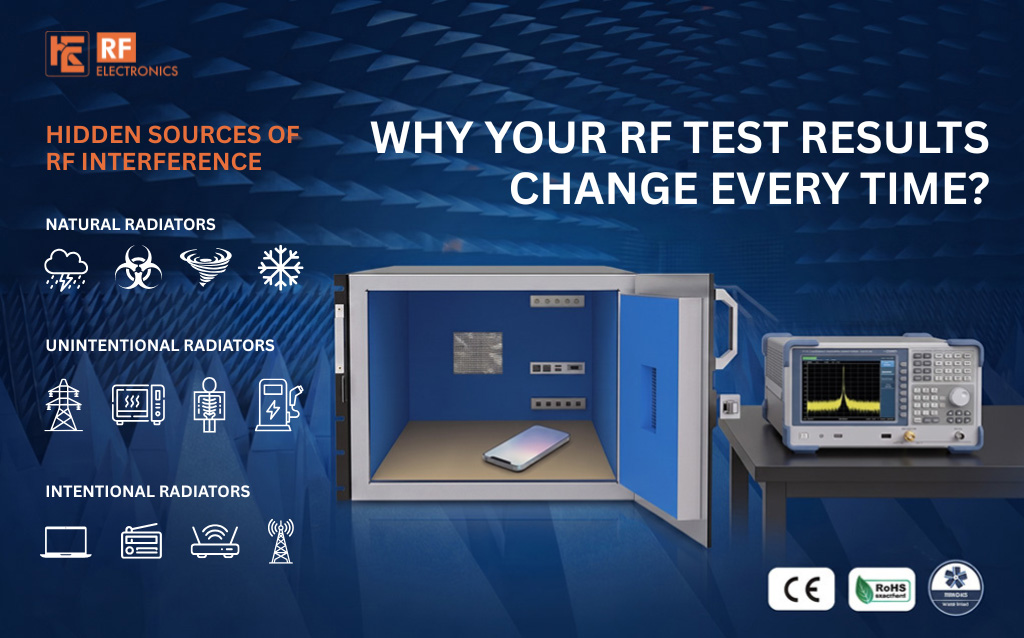
Modern offices, laboratories, and production facilities are surrounded by wireless signals. Wi-Fi access points, Bluetooth devices, smartphones, cellular networks, IoT devices, and other RF equipment can all introduce unwanted signals into a test setup.
This can affect measurements such as:
For example, an engineer may test a Wi-Fi device and obtain different results at different times of the day. The device itself has not changed, but the RF environment around it may have.
Use a controlled RF testing environment whenever isolation is important.
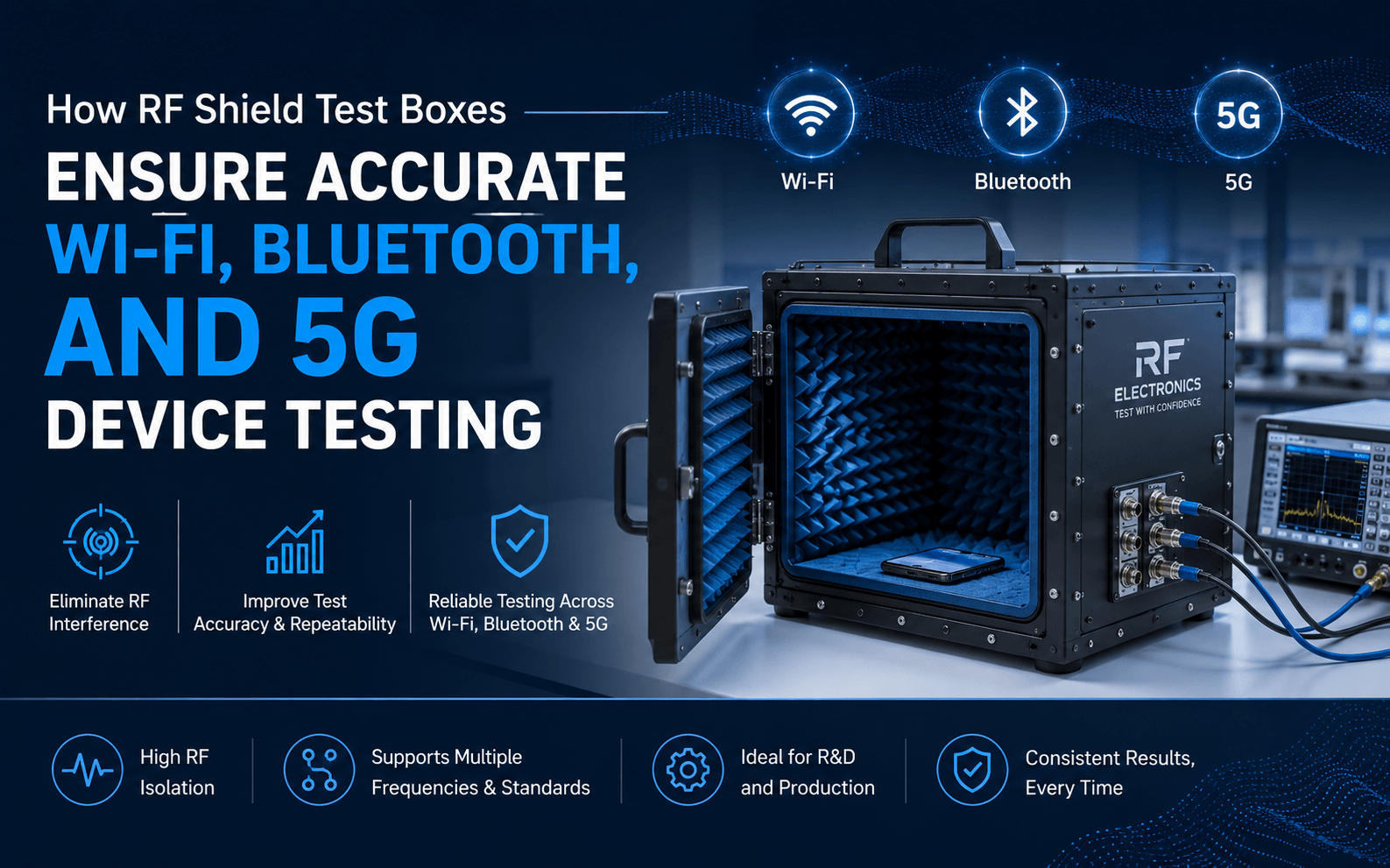
An RF Shield Box or RF Shield Test Box can isolate the Device Under Test from external RF signals and reduce signal leakage. This helps engineers create consistent testing conditions and obtain more repeatable measurements.
For more complex testing requirements, shielded enclosures, RF test chambers, or complete RF test environments may be appropriate.
If the RF environment is uncontrolled, even highly accurate test equipment may produce unreliable results.
RF cables are often treated as simple connections between instruments and the DUT. In reality, they are an important part of the measurement chain.
A cable can introduce signal loss, reflections, impedance mismatch, and other performance issues that affect the final measurement.
Important RF cable characteristics include:
These factors become increasingly important as test frequencies increase.
A cable that performs adequately at lower frequencies may not deliver the same performance at higher frequencies.
Select RF cables based on the actual requirements of the application rather than simply choosing the most convenient or inexpensive option.
Engineers should consider:
Frequency range: Ensure the cable supports the complete operating frequency range.
Impedance: Most RF systems use 50-ohm impedance, but the complete signal path should be matched appropriately.
Insertion loss: Lower loss is important when accurate signal levels need to be maintained.
Connector compatibility: SMA, N-Type, 2.92 mm, 2.4 mm, and other connectors have different application requirements.
Mechanical requirements: In compact test setups, conformable RF cables can provide controlled routing while maintaining RF performance.
The cable is part of the measurement system. Poor cable selection can compromise an otherwise well-designed RF test setup.
Another costly mistake is changing the physical test configuration between measurements.
Small changes in cable routing, DUT positioning, connector connections, antenna orientation, or instrument settings can affect RF measurements.
This becomes particularly important when comparing:
If the test setup changes between measurements, engineers may struggle to determine whether a performance difference comes from the product or the test environment.
Create a standardized test procedure.
Document important setup parameters such as:
Photographs or diagrams of the approved test setup can also help technicians reproduce the same configuration.
For production environments, automated test systems can further reduce variations caused by manual setup.
Repeatable testing requires repeatable test conditions.
High-end RF instruments are essential for accurate measurements, but the instrument itself is only one part of the complete testing system.
A test setup may include:
If one component introduces uncertainty, the final measurement can be affected.
For example, a highly accurate spectrum analyzer cannot compensate for excessive signal loss in a cable or interference entering through an inadequately shielded enclosure.
Evaluate the complete RF signal path instead of focusing on individual instruments.
Ask:
A system-level approach helps engineers identify the actual source of measurement uncertainty.
Accurate RF testing is a system-level process—not simply an instrument-level process.
A manual RF test setup may work well during early R&D, but it can become inefficient when testing requirements increase.
As the number of devices grows, manually connecting equipment, positioning DUTs, recording results, and repeating test sequences can introduce:
This is particularly important for manufacturers testing large volumes of wireless devices.
Consider automation requirements early in the test system design.
Modern RF Shield Boxes can be integrated into automated testing environments, allowing engineers to combine shielding with automated measurements and device handling.
Depending on the application, an automated RF test setup may include:
The objective is not simply to make testing faster. A well-designed automated system can also improve repeatability and reduce operator-dependent variations.
Designing for scalability from the beginning can prevent expensive changes later.
These mistakes may appear small individually, but their impact can accumulate throughout a product development cycle.
For example, an inconsistent test environment can lead to a false failure. Engineers then spend hours investigating the device, modifying firmware, changing hardware, or repeating measurements.
If the actual problem was external RF interference, all of that engineering effort could have been avoided.
The consequences can include:
This is why establishing a reliable RF test infrastructure early in the development process is so important.
Before starting an RF test, engineers can use a simple checklist:
Environment
RF Shielding
Measurement Equipment
Automation
Following these checks can significantly improve testing consistency and reduce avoidable troubleshooting.
A reliable RF test environment requires more than measurement instruments. The supporting infrastructure must also be designed around the application's electrical and mechanical requirements.
RF Electronics provides RF testing solutions including RF Shield Boxes, RF Shield Test Boxes, RF test racks, RF coaxial cables, and related RF testing infrastructure for applications across telecom, IoT, aerospace, defense, research, and wireless product development.
These solutions can help engineers establish controlled and repeatable test environments for R&D, validation, and production testing.
The right combination of RF shielding, high-quality RF cables, test infrastructure, and automation can make testing more reliable while reducing unnecessary retesting and development delays.
RF testing accuracy depends on much more than having sophisticated measurement equipment.
Poor RF isolation, unsuitable cables, inconsistent test setups, an instrument-focused approach, and a lack of scalability can all introduce errors and increase testing costs.
By controlling the RF environment, selecting appropriate cables, standardizing test procedures, evaluating the complete signal path, and planning for automation, engineers can create more reliable and repeatable testing processes.
For today's Wi-Fi, Bluetooth, 5G, and IoT products, a well-designed RF test environment is not simply a testing convenience—it is an important part of successful product development and quality assurance.
What is the most common mistake in RF testing?
Poor control of the RF test environment is one of the most common issues. External RF interference can affect measurements and create inconsistent results, particularly when testing sensitive wireless devices.
How does RF interference affect test results?
Unwanted RF signals can interfere with the Device Under Test and measurement equipment, potentially affecting parameters such as signal strength, sensitivity, throughput, and packet performance.
Why are RF cables important for accurate testing?
RF cables are part of the signal path and can introduce insertion loss, reflections, impedance mismatch, and other effects. Selecting cables appropriate for the frequency and application helps maintain measurement accuracy.
How can I make RF testing more repeatable?
Standardize the physical setup, instrument configuration, cable routing, DUT positioning, and test procedure. Using an RF Shield Box can also help create consistent environmental conditions.
Do I need an RF Shield Box for wireless device testing?
It depends on the application. If external RF interference can affect the measurement, an RF Shield Box provides a controlled environment that can improve test repeatability and accuracy.
Can RF Shield Boxes be used for production testing?
Yes. RF Shield Boxes can be integrated into production test systems and, depending on the design, can support automated testing for high-volume wireless device validation.
What should I consider when choosing an RF cable?
Consider frequency range, impedance, insertion loss, VSWR, shielding, connector type, cable length, and mechanical requirements.
How can automation improve RF testing?
Automation can reduce manual intervention, standardize test sequences, improve repeatability, increase throughput, and simplify data collection.
Previous Blog
Why Your RF Test Results Change Every Time Hidden Sources of RF Interference
Learn MoreNext Blog
How RF Shield Test Boxes Ensure Accurate Wi-Fi, Bluetooth, and 5G Device Testing
Learn More

 Free Consultation


