
Jul 10, 2026
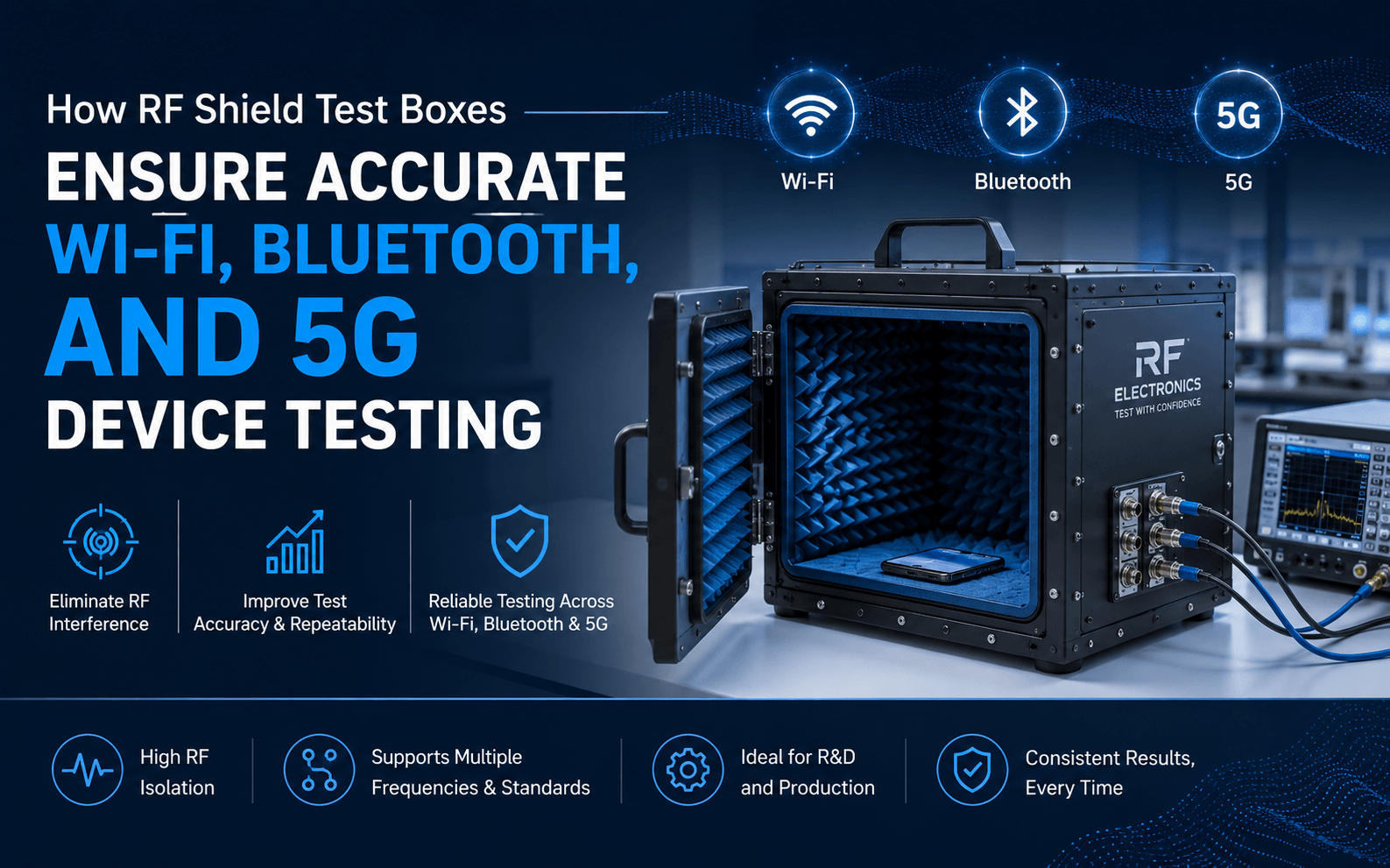
The rapid growth of wireless technologies has transformed how devices communicate. Smartphones, IoT sensors, smart home products, industrial equipment, and 5G-enabled devices all rely on stable wireless performance to deliver a seamless user experience.
For manufacturers and R&D teams, however, ensuring that these devices perform reliably is becoming increasingly challenging. Modern wireless products often support multiple communication standards including Wi-Fi, Bluetooth, 5G, NFC, Zigbee, and other protocols—making testing far more complex than it was just a few years ago.
One of the biggest obstacles during wireless validation is unwanted RF interference. Nearby wireless devices, office Wi-Fi networks, Bluetooth peripherals, cellular signals, and even adjacent test benches can influence measurements and produce inconsistent results.
This is why RF Shield Test Boxes have become an essential part of modern RF testing environments. They create a controlled, isolated space where engineers can evaluate wireless performance without external interference, ensuring accurate, repeatable, and reliable results throughout both product development and production.
Wireless products are expected to work flawlessly from the moment they reach customers.
A smartwatch should pair instantly.
A Wi-Fi router should deliver stable connectivity.
A Bluetooth headset should maintain uninterrupted communication.
An industrial IoT sensor should transmit reliable data even in challenging environments.
To achieve this level of performance, manufacturers cannot rely on testing performed in uncontrolled environments.
Even minor RF interference during development can lead to:
Accurate testing begins with a stable testing environment, and that's exactly what an RF Shield Test Box provides.
Many engineers assume their testing equipment is responsible for inconsistent results when, in reality, the surrounding environment is the problem.
Common interference sources include:
These unwanted signals create unpredictable testing conditions.
One test may pass.
The next may fail.
The device hasn't changed, but the environment has.
This inconsistency slows development and makes troubleshooting significantly more difficult.
An RF Shield Test Box is a specially designed enclosure that blocks external radio frequency signals while preventing signals from the device under test from leaking into the surrounding environment.
Inside the enclosure, engineers can evaluate wireless devices under tightly controlled conditions.
Rather than competing with dozens of surrounding RF sources, the device communicates only with the intended testing equipment.
This creates repeatable and highly accurate measurements.
The biggest advantage of an RF Shield Test Box is isolation.
By blocking outside wireless signals, engineers obtain clean measurement data without environmental interference.
Benefits include:
One of the most important goals in RF testing is repeatability.
If a product is tested today, tomorrow, or next week, the results should remain consistent.
Without shielding, environmental changes affect measurements.
With an RF Shield Test Box:
Modern devices rarely use only one wireless technology.
A single IoT product may include:
Testing each radio independently requires isolation.
RF Shield Test Boxes allow engineers to validate multiple wireless technologies without cross-interference.
False failures are expensive.
Products that actually perform correctly may fail because external RF signals interfere with testing.
Each false failure results in:
Using an RF Shield Test Box dramatically reduces these unnecessary failures.
Wi-Fi devices operate in increasingly crowded spectrum bands.
With Wi-Fi 6, Wi-Fi 6E, and Wi-Fi 7 introducing wider bandwidths and higher throughput, testing requirements continue to become more demanding.
RF Shield Test Boxes help engineers verify:
without interference from surrounding wireless networks.
Bluetooth products are everywhere.
Examples include:
Because Bluetooth operates in the same spectrum used by many nearby devices, testing in open environments often produces inconsistent results.
Shielded testing ensures reliable validation of:
5G introduces entirely new testing challenges.
Higher frequencies.
Massive bandwidth.
Beamforming.
Advanced antenna systems.
These technologies demand highly controlled RF environments.
RF Shield Test Boxes support:
making them essential for manufacturers developing next-generation wireless products.
An RF Shield Test Box is valuable at every stage of product development.
This versatility makes RF Shield Test Boxes a long-term investment rather than a single-purpose testing tool.
Selecting the right solution depends on your testing requirements.
Consider factors such as:
The right configuration improves both testing efficiency and long-term flexibility.
RF Electronics designs and manufactures high-performance RF Shield Test Boxes for wireless testing applications across telecom, aerospace, defense, consumer electronics, and research laboratories.
Key advantages include:
Every solution is engineered to deliver consistent, repeatable, and accurate RF measurements.
As wireless technologies continue to evolve, the demand for precise and repeatable testing has never been greater. Whether you're developing a Bluetooth wearable, a Wi-Fi access point, or a 5G communication module, accurate testing depends on eliminating external RF interference.
An RF Shield Test Box provides the controlled environment needed to validate wireless performance with confidence, helping engineers reduce false failures, improve product quality, and accelerate time-to-market.
For organisations focused on building reliable wireless products, investing in the right RF shielding solution is not just a technical decision—it's a strategic advantage.
An RF Shield Test Box is a shielded enclosure that blocks external RF signals and prevents signal leakage during testing. It provides a controlled environment for accurate testing of wireless devices such as Wi-Fi, Bluetooth, IoT, and 5G products.
Wireless devices are sensitive to external RF interference. An RF Shield Test Box ensures consistent and repeatable test conditions, helping engineers obtain accurate results and reduce false failures.
RF Shield Test Boxes support testing for a wide range of wireless technologies, including:
By isolating the Device Under Test (DUT) from external RF signals, the shield box eliminates interference, ensuring stable measurements, repeatable results, and accurate evaluation of wireless performance.
Yes. Many RF Shield Test Boxes are designed to integrate with automated production testing systems, robotic DUT handling, and automated test equipment (ATE), improving testing efficiency and throughput.
RF Shield Test Boxes are widely used in:
Key factors include:
Selecting the right specifications ensures reliable testing for your application.
Yes. Most modern RF Shield Test Boxes are designed to support multiple wireless technologies, allowing engineers to test Wi-Fi, Bluetooth, and other RF devices within the same controlled environment.
Accurate and repeatable testing reduces debugging time, minimises retesting, identifies issues earlier in the development cycle, and accelerates product validation, helping manufacturers bring products to market faster.
Previous Blog
.png)
5 Costly RF Testing Mistakes Engineers Make (And How to Avoid Them)
Learn MoreNext Blog
The Importance of RF Test Infrastructure in Telecom and IoT
Learn More

 Free Consultation


