
Sep 04, 2026
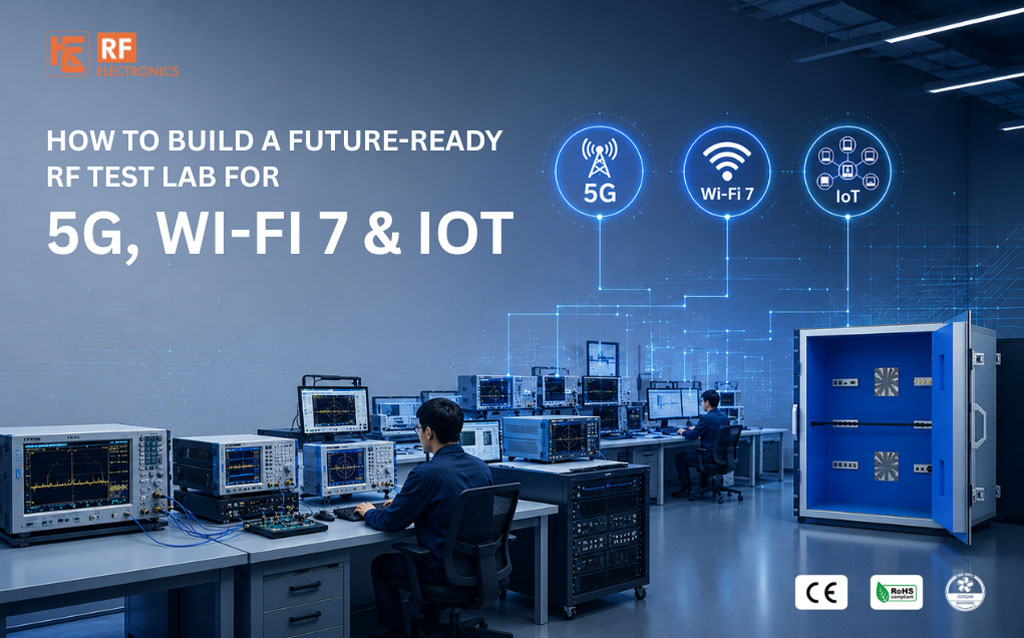
Wireless devices are evolving faster than many traditional test laboratories can adapt.
A single device may now combine Wi-Fi, Bluetooth, cellular connectivity, GNSS, IoT protocols, and multiple antennas. At the same time, technologies such as 5G and Wi-Fi 7 are introducing higher data rates, wider bandwidths, more complex radio configurations, and increasingly demanding validation requirements.
This creates a practical challenge for RF engineers:
How do you build an RF test lab today that will still support tomorrow's wireless products?
The answer is not simply to purchase more test equipment. A future-ready RF test lab requires the right combination of RF isolation, measurement equipment, signal paths, test fixtures, automation, infrastructure, and scalability.
This guide explains the key components to consider when designing an RF test environment for 5G, Wi-Fi 7, IoT, and other next-generation wireless technologies.
Traditional RF testing was often built around individual instruments and manual measurements.
Modern wireless products are much more complicated.
A current IoT or consumer electronics device may contain several wireless interfaces operating simultaneously. A 5G device may require testing across multiple bands and configurations. Wi-Fi 7 introduces capabilities such as Multi-Link Operation and wider channel bandwidths that increase the complexity of wireless validation.
This means the test environment itself has become an important part of the measurement system.
A laboratory must provide:
A lab designed only around today's product requirements can quickly become difficult or expensive to upgrade.
Before purchasing RF test equipment, define the devices and technologies the laboratory needs to support.
Consider:
For example, a laboratory testing a small Bluetooth module will have very different infrastructure requirements from a facility testing a large 5G router or multi-antenna IoT gateway.
The test system should therefore be designed around the DUT and measurement objectives, not simply around available equipment.
One of the biggest challenges in wireless testing is unwanted RF interference.
A modern laboratory can contain numerous sources of RF energy:
These signals can interfere with sensitive measurements and make results difficult to reproduce.
This is where RF shielding becomes essential.
An RF Shield Box creates a controlled environment around the Device Under Test (DUT), reducing the influence of external RF signals and helping engineers perform more repeatable measurements.
RF Electronics' shield-box solutions are designed for wireless testing applications including WLAN, Bluetooth, RFID, 3G, 4G and 5G testing, with configurable I/O options and RF absorbing materials to help control reflections.
Not every RF Shield Box is suitable for every application.
When selecting one, engineers should evaluate:
Frequency range
The enclosure should support the frequencies used by the DUT and test equipment.
RF isolation
Isolation requirements depend on the application and the strength of external signals that need to be attenuated.
Internal dimensions
The DUT must fit comfortably while maintaining the required test configuration.
I/O interfaces
Modern devices often need power, USB, LAN, RF, control, and other interfaces while remaining isolated from external RF signals.
Absorption and reflections
Internal RF absorber materials can help reduce standing waves and unwanted reflections inside the enclosure.
Automation compatibility
If the laboratory may move toward automated testing, the shield box should be capable of integration with the planned system.
Some RF Electronics shield-box models are available with filtered power and I/O options and are designed for applications ranging from WLAN and Bluetooth to 5G FR1.
A test lab is only as reliable as its complete RF signal path.
The path may include:

Every component can influence the final measurement.
Important parameters include:
This is why RF cables should not be treated as simple accessories.
A poor-quality or incorrectly selected cable can introduce additional loss or reflections and affect measurement accuracy.
As frequencies increase, cable selection becomes increasingly important.
Engineers should consider:
For compact or frequently reconfigured test systems, conformable RF cables can be useful where controlled routing is required.
The objective is to ensure that the cable does not become an uncontrolled variable in the measurement chain.
A future-ready laboratory may require several types of RF measurement equipment depending on the application.
Common equipment includes:
Vector Network Analyzer
Used for measuring parameters such as S-parameters, impedance, return loss, and insertion loss.
Spectrum Analyzer
Used to examine frequency-domain signals, spurious emissions, interference, and spectral characteristics.
Signal Generator
Provides controlled RF signals for receiver and performance testing.
Power Meter
Used for accurate RF power measurements.
RF Switching Systems
Useful when one test setup needs to connect multiple devices, ports, antennas, or instruments.
Protocol-Specific Test Systems
Depending on the application, laboratories may also require dedicated systems for 5G, Wi-Fi, Bluetooth, IoT, or other wireless technologies.
The important point is that these instruments should be integrated into a coherent test architecture rather than operating as isolated pieces of equipment.
Wi-Fi 7 is increasing the complexity of wireless testing.
The technology introduces advanced capabilities such as:
This creates additional demands on the test environment.
A future-ready lab should therefore consider:
RF Electronics' shield-box portfolio includes models specified for WLAN standards including 802.11a/b/g/n/ac/ax/be, supporting the broader evolution from earlier Wi-Fi generations toward Wi-Fi 7.
5G testing introduces its own set of challenges.
Depending on the device and test requirements, engineers may need to evaluate:
For 5G devices, the lab should be designed around the required frequency range and whether the testing is conducted, radiated, or a combination of both.
For example, RF Electronics' shield-box solutions include configurations intended for 5G FR1 device testing and can be customized with different I/O requirements.
For larger or more complex radiated measurements, an RF chamber or other controlled environment may be more appropriate.
IoT devices can be particularly challenging because they often combine multiple wireless technologies in a small form factor.
An IoT product might include:
The laboratory therefore needs to support both individual radio testing and, where required, testing of how those technologies behave within the complete product.
A flexible RF Shield Box with appropriate I/O interfaces can simplify controlled testing of individual DUTs.
A future-ready RF lab should be easy to modify.
Technology changes quickly, and test requirements can change with new products.
Instead of building a rigid setup, consider modular infrastructure such as:
RF Electronics provides modular I/O filter plate solutions and customizable RF Shield Boxes, allowing test configurations to be adapted to application-specific requirements.
This can be especially useful when the laboratory supports multiple product teams.
Manual testing may be acceptable during early R&D.
But as test volumes increase, manual workflows can become a bottleneck.
A production-oriented RF test system may involve:

Automation can reduce operator involvement in repetitive steps and improve consistency.
Possible automation elements include:
RF test racks can be particularly useful when multiple devices need to be tested or when testing moves toward higher throughput. RF Electronics' product range includes RF Test Racks and RF Test Platform Racks for larger test environments.
A laboratory for five prototypes per week does not need the same infrastructure as a production line testing hundreds or thousands of devices.
Ask:
These questions help determine whether a benchtop shield box, rack-mounted system, multiple test stations, or an RF test rack is appropriate.
Planning for throughput early can prevent expensive infrastructure changes later.
RF testing isn't only about RF signals.
Some DUTs generate significant heat during testing. Others require cooling, power, mechanical fixtures, or movement.
The test environment may therefore require:
For example, some RF Shield Test Box designs incorporate filtered power and controlled ventilation while maintaining RF shielding.
The exact solution should be determined by the DUT's operating requirements and the required RF performance.
A future-ready RF lab should produce measurements engineers can trust.
Repeatability depends on controlling variables such as:
Standard operating procedures should document the approved configuration.
Photographs, fixture drawings, cable diagrams, and instrument settings can help different engineers reproduce the same test.
The most important part of a future-ready lab is flexibility.
When designing the infrastructure, consider whether it can accommodate:
This does not mean purchasing every possible piece of equipment today.
Instead, design the infrastructure so that future equipment can be integrated without rebuilding the entire laboratory.
A typical scalable architecture could look like this:

This approach separates the DUT environment from the measurement and control infrastructure, making the system easier to expand.
The right solution depends on the testing objective.

There is no universal answer.
A shield box is often practical for controlled device-level testing, while a chamber may be preferable when the DUT, antenna configuration, or measurement methodology requires a larger radiated environment.
Mistake 1: Buying equipment before defining the test requirements
This can lead to expensive equipment that does not fit the actual workflow.
Mistake 2: Ignoring RF isolation
Even excellent instruments cannot eliminate interference entering through an uncontrolled environment.
Mistake 3: Treating RF cables as accessories
Cable loss and connector performance can affect the measurement chain.
Mistake 4: Designing only for today's devices
A lab that cannot accommodate future frequency bands, DUT sizes, or I/O requirements may quickly become obsolete.
Mistake 5: Waiting too long to consider automation
Retrofitting automation into a manually designed system can be more complicated than planning for it from the beginning.
Before finalising an RF test lab, ask:
RF Environment
Frequency
DUT
Signal Path
Equipment
Infrastructure
Automation
Production
A laboratory that answers these questions before implementation is far more likely to remain useful as wireless technologies evolve.
Building an RF test lab is not simply about purchasing individual products. The shielded environment, signal path, fixtures, test equipment, and automation need to work together.
RF Electronics provides RF and microwave test products including:
These solutions can be configured for wireless testing applications across 5G, Wi-Fi, Bluetooth, IoT, telecommunications, aerospace, defense, research, and industrial applications.
The company also provides customized solutions where standard configurations do not meet the DUT, interface, size, or testing requirements.
A future-ready RF test lab is not defined by how many instruments it contains.
It is defined by how effectively the entire testing environment works together.
For 5G, Wi-Fi 7, and IoT devices, engineers need controlled RF environments, reliable signal paths, appropriate measurement equipment, repeatable DUT positioning, flexible infrastructure, and a clear path toward automation.
The most effective approach is to design the laboratory around today's testing requirements while leaving enough flexibility for tomorrow's devices and wireless standards.
With the right combination of RF Shield Boxes, RF Chambers, RF cables, test racks, measurement equipment, and automation, organizations can build an RF testing environment that supports accurate measurements today and remains scalable as wireless technology continues to evolve.
1. What equipment is needed to build an RF test lab?
Depending on the application, an RF test lab may require RF Shield Boxes or chambers, signal generators, spectrum analyzers, vector network analyzers, power meters, RF cables, connectors, switching systems, fixtures, and test automation software.
2. Why is RF isolation important in a test lab?
RF isolation reduces unwanted external signals that can interfere with measurements. A controlled environment can improve test repeatability and help engineers distinguish actual DUT performance from environmental effects.
3. What is the role of an RF Shield Box in an RF test lab?
An RF Shield Box provides a controlled enclosure around the DUT, helping reduce external RF interference and limit unwanted RF signal leakage during wireless testing.
4. Can the same RF test lab support 5G, Wi-Fi 7, and IoT testing?
Yes, if the laboratory is designed with appropriate frequency coverage, RF isolation, interfaces, test equipment, fixtures, and software. The exact configuration depends on the devices and test requirements.
5. How do I choose between an RF Shield Box and an RF Chamber?
Consider DUT size, test methodology, antenna configuration, required RF environment, testing volume, and whether radiated or conducted measurements are required. A shield box is often suited to controlled device-level testing, while a chamber may be more appropriate for larger or specialized radiated measurements.
6. Why are RF cables important in an RF test lab?
RF cables form part of the measurement signal path. Their insertion loss, VSWR, impedance, shielding, connector quality, and frequency capability can influence test results.
7. How can RF testing be automated?
Automation can combine RF Shield Boxes, switching systems, programmable instruments, DUT fixtures, test software, and data collection systems to reduce manual intervention and improve test repeatability.
8. What should I consider when planning a future-ready RF test lab?
Consider frequency range, RF isolation, DUT size, testing volume, signal path, I/O requirements, automation, modularity, and the ability to integrate future equipment.
9. Can RF Electronics customize RF test equipment?
Yes. RF Electronics provides customized RF testing solutions based on application-specific requirements, including enclosure dimensions, I/O configurations, interfaces, and integrated test setups.
10. What wireless technologies can RF Electronics test solutions support?
RF Electronics solutions are used for wireless testing applications including Wi-Fi/WLAN, Bluetooth, RFID, cellular technologies including 5G, and IoT-related applications.
Previous Blog
RF Shield Box Buying Guide Everything Engineers Need to Know
Learn MoreNext Blog
Why Your RF Test Results Change Every Time Hidden Sources of RF Interference
Learn More

 Free Consultation


