
Sep 09, 2026
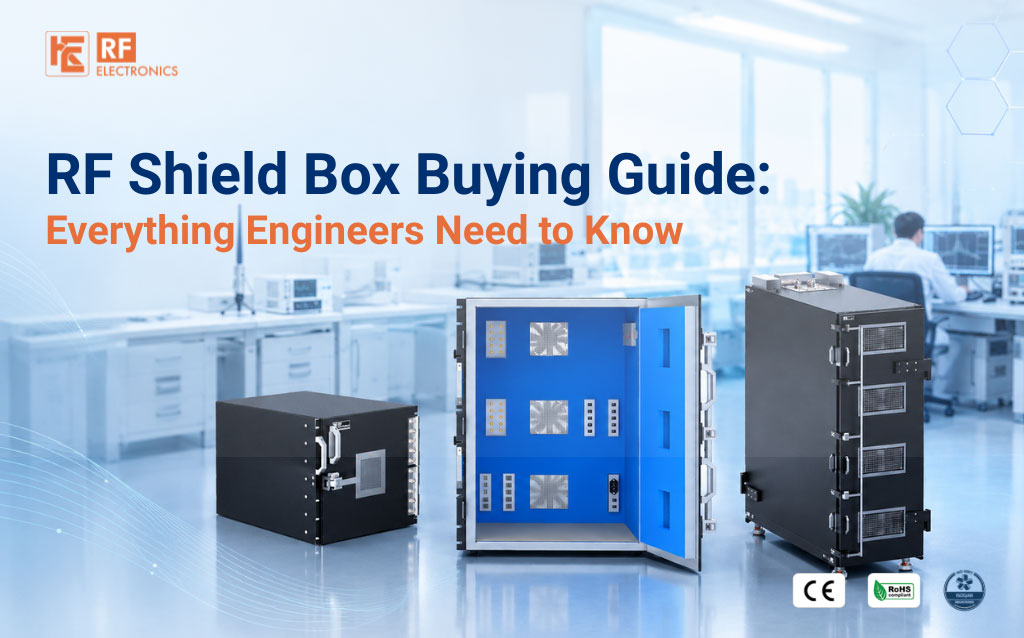
Choosing the right RF Shield Box is an important decision for engineers working on wireless device testing. The wrong enclosure can create measurement inconsistencies, limit connectivity, restrict future testing requirements, or become difficult to integrate into an automated test system.
With wireless devices becoming more complex, engineers may need to test Wi-Fi, Bluetooth, 5G, LTE, RFID, IoT, GNSS, and other RF technologies within controlled environments.
But not every RF Shield Box is designed for every application.
The right choice depends on several technical and practical factors, including frequency range, RF isolation, DUT size, internal configuration, I/O interfaces, cable requirements, cooling, automation, and testing volume.
This guide explains the most important factors to consider before selecting an RF Shield Box for an R&D, validation, pre-compliance, or production testing environment.
An RF Shield Box is a shielded enclosure designed to isolate a Device Under Test (DUT) from external RF signals and provide a controlled environment for wireless testing.
The enclosure helps reduce unwanted RF interference entering the test environment and can also help contain RF signals generated by the DUT.
RF Shield Boxes are commonly used for testing:
RF Electronics offers RF Shield Boxes in different configurations, including benchtop, rack-mounted, and standalone solutions for wireless testing applications.
An RF Shield Box is not simply a metal enclosure.
Its performance depends on the complete system, including the enclosure construction, door sealing, RF absorbers, connectors, filtered I/O, ventilation, and other interfaces.
A poorly matched shield box can result in:
The objective should therefore be to select a shield box based on the actual test requirements, rather than choosing a model only because it has a high isolation specification.
The first question should be:
What exactly are you planning to test?
Different applications require different shield-box configurations.
For example:
Wi-Fi Testing
You may need support for 2.4 GHz, 5 GHz, or newer Wi-Fi configurations, depending on the DUT.
The enclosure needs to support the relevant 2.4 GHz testing requirements while providing suitable antenna or RF interfaces.
The required frequency range and test architecture depend on whether the application involves 5G FR1, conducted testing, radiated testing, or other configurations.
IoT devices may combine multiple radios such as Wi-Fi, Bluetooth, cellular, GNSS, Zigbee, or other technologies.
Production Testing
High-volume testing may require automation, fast door operation, standardized fixtures, and integration with test software.
Before comparing models, clearly define the wireless technologies, frequency bands, DUT type, and testing stage.
One of the most important specifications is the operating frequency range.
Do not select a shield box simply because it works for today's device.
Consider:
For example, a shield box designed around lower-frequency wireless testing may not provide the same performance requirements needed for higher-frequency applications.
RF Electronics provides shield-box configurations with isolation specifications extending across multiple frequency points, with some models specified up to 12 GHz.
Buying tip:
Choose a model based on the complete frequency range of your testing program, not just the primary frequency of your current DUT.
RF isolation is one of the most important specifications when evaluating an RF Shield Box.
It describes how effectively the enclosure reduces RF signal coupling between the inside and outside environment.
Higher isolation can be particularly important when:
However, isolation should always be considered across the frequency range, not as a single number.
For example, an RF Electronics model may specify:
The exact specification depends on the model and configuration.
Important
Do not compare two shield boxes using only their maximum isolation number.
Check where that isolation is achieved and across which frequencies.
The Device Under Test must fit comfortably inside the enclosure.
But simply checking whether the DUT physically fits is not enough.
You should also consider:
A small smartphone or wireless module may work well in a compact benchtop shield box.
A larger router, automotive electronics module, development platform, or complex test fixture may require a larger standalone or rack-mounted enclosure.
RF Electronics offers standalone configurations intended for larger DUTs, custom fixtures, and applications requiring greater internal space.
Buying tip
Always compare internal dimensions, not just the external dimensions of the box.
RF Shield Boxes are available in different physical configurations.
Benchtop RF Shield Box
Best suited for:
They are convenient when engineers need direct access to the test enclosure.
Rack-Mounted RF Shield Box
Best suited for:
RF Electronics offers 24-inch rack-mounted configurations designed for wireless device testing and integration into rack-based test platforms.
Standalone RF Shield Box
Best suited for:
The right format depends on the size of the DUT and how the test station will be used.
This is one of the most commonly overlooked parts of RF Shield Box selection.
Your DUT may need connections for:
The shield box must allow these connections without compromising the shielding performance.
RF Electronics provides a range of I/O connector options and customizable configurations for application-specific testing requirements.
Before ordering, create an I/O list
For example:

This simple step can prevent major integration problems later.
Your shield box is only one part of the RF signal path.
The complete path may look like:

The cable can introduce:
Therefore, cable selection should match the frequency range and measurement requirements.
Consider:
For frequently adjusted setups, conformable RF cables can provide useful mechanical flexibility while maintaining controlled RF routing.
An RF Shield Box should not only block external signals.
Internal reflections can also affect measurements.
Metallic surfaces can reflect RF energy, creating unwanted signal paths inside the enclosure.
RF absorber materials can help reduce:
RF Electronics uses RF absorbing materials in its shield-box designs to help control standing waves and reflections during testing.
This can be particularly important for wireless and antenna-related measurements.
Many DUTs need power while being tested.
Simply bringing a power cable into a shielded enclosure can create a path for unwanted RF signals.
This is why filtered power connections are important.
A properly designed shield box can provide power to the DUT while maintaining the required RF shielding.
RF Electronics' shield-box configurations include shielded power filters designed to provide power connections while maintaining RF isolation.
When evaluating a shield box, ask:
Some wireless devices generate significant heat during testing.
The shield box therefore needs a practical thermal management solution.
Depending on the design, this may include:
RF Electronics models include cooling fans and cut-off waveguide ventilation configurations while maintaining the shielded enclosure design.
Why this matters
A DUT that becomes excessively hot during a long test can behave differently from a DUT operating at its normal temperature.
Thermal management is therefore part of test repeatability.
Think about how the shield box will be used.
Manual Shield Box
Suitable for:
Automated Shield Box
More appropriate for:
Automation may include:
If automation is part of your future plan, select a shield box that can support it rather than replacing the enclosure later.
An RF Shield Box should help you create a consistent test environment.
But repeatability depends on more than shielding.
Also consider:
A good shield box should be part of a standardized test setup.
If the DUT is positioned differently every time, even a high-isolation enclosure may not produce identical results.
Your requirements can change as a product moves through development.
R&D
Priorities may include:
Validation
Priorities may shift toward:
Production
Priorities often include:
Therefore, the "best" RF Shield Box depends on where it will be used.
Wireless technology changes quickly.
Today's test setup may need to support new requirements later.
Before purchasing, consider:
A slightly more flexible configuration today may prevent a costly replacement later.
An RF Shield Box and an RF Chamber are not interchangeable in every application.

An RF Shield Box is often a practical choice when testing individual devices in a controlled enclosure.
A larger chamber may be more appropriate when the test requires greater physical space or a specific radiated/OTA environment.
Mistake 1: Choosing based only on price
A cheaper enclosure may not provide the required isolation, interfaces, or long-term flexibility.
Mistake 2: Looking at only one isolation value
Always examine isolation across the complete frequency range.
Mistake 3: Forgetting the I/O
The box may fit the DUT but not provide the connections required for testing.
Mistake 4: Ignoring internal dimensions
External dimensions do not tell you how much usable space is available for the DUT and fixture.
Mistake 5: Forgetting thermal requirements
High-power or long-duration DUT testing may require ventilation or cooling.
Mistake 6: Ignoring automation
A manual enclosure may become a bottleneck if testing volume increases.
Mistake 7: Selecting a box without considering the RF signal path
Cables, connectors, adapters, and filters can influence overall test performance.
Before selecting a model, confirm these requirements:
Application
Frequency
Isolation
DUT
I/O
Physical Configuration
Automation
RF Signal Path
Future Scalability
There is no single RF Shield Box that is ideal for every application.
A small engineering team testing wireless modules may benefit from a compact benchtop enclosure.
A production facility may need rack-mounted shield boxes integrated with automated test equipment.
A research laboratory testing larger platforms may require a standalone enclosure with custom dimensions and I/O.
The right selection should therefore start with the test requirements, followed by the technical specifications.
RF Electronics offers RF Shield Box solutions for wireless testing applications across telecommunications, automotive, IoT, defense, aerospace, research, and industrial environments.
Its range includes:
RF Electronics' product range supports applications including Wi-Fi, Bluetooth, RFID, LTE, 5G, and IoT, with options for customized dimensions, I/O interfaces, automation, cooling, and internal layouts.
For example, its HDRF-11U2432 rack-mounted shield box is designed for WLAN and wireless device testing and supports applications including Wi-Fi, Bluetooth, RFID, LTE, and 5G.
The company can also customize RF Shield Box configurations according to DUT size, interfaces, testing requirements, and application-specific needs.
Choosing an RF Shield Box should not be treated as a simple equipment purchase.
The right enclosure needs to match your frequency range, required RF isolation, DUT size, I/O requirements, RF signal path, cooling needs, testing volume, and automation plans.
A well-selected RF Shield Box can help create a controlled testing environment, reduce external interference, improve repeatability, and support more reliable wireless device development and validation.
Before making a decision, define your testing requirements first and then compare shield boxes based on their actual technical specifications.
For long-term value, don't just ask:
"Which RF Shield Box has the highest isolation?"
Ask:
"Which RF Shield Box is designed for the way we actually test?"
That is the better starting point for selecting the right RF shielding solution.
1. What is the most important specification when buying an RF Shield Box?
There is no single specification that determines suitability. Frequency range, RF isolation, DUT size, I/O requirements, internal configuration, and automation requirements should all be considered together.
2. How much RF isolation do I need?
The required isolation depends on the application, external RF environment, DUT signal levels, and measurement objectives. Always evaluate the isolation specification across the frequencies you actually need to test.
3. Can one RF Shield Box test Wi-Fi, Bluetooth, and 5G devices?
Yes, provided the shield box supports the required frequency range, isolation, DUT configuration, and interfaces. RF Electronics offers configurations intended for multiple wireless technologies.
4. What size RF Shield Box should I choose?
Choose based on the DUT's physical dimensions plus any fixtures, antennas, cables, and other components that need to be inside the enclosure. Always check the internal working dimensions.
5. What is the difference between a benchtop and rack-mounted RF Shield Box?
A benchtop model is generally convenient for R&D and individual testing, while rack-mounted models are designed for integration into rack-based test platforms and production environments.
6. Do RF Shield Boxes need internal RF absorbers?
Absorbers can help reduce internal reflections and standing waves, depending on the test application and enclosure design. RF Electronics uses RF absorbing materials in its shield-box configurations for this purpose.
7. Do I need filtered power inside an RF Shield Box?
If the DUT needs external power during testing, the power interface should be designed so that it does not unnecessarily compromise the RF shielding. Filtered power is commonly used for this purpose.
8. Can an RF Shield Box be customized?
Yes. Customization can include enclosure dimensions, connectors, I/O interfaces, cooling, internal layouts, and automation features depending on the application.
9. Can RF Shield Boxes be used for automated testing?
Yes. RF Shield Boxes can be integrated into automated test platforms using appropriate door mechanisms, fixtures, switching systems, instruments, and software.
10. Should I choose an RF Shield Box or RF Chamber?
For compact, controlled DUT testing, an RF Shield Box is often more practical. Larger or specialized radiated/OTA applications may require an RF Chamber. The decision should be based on the DUT and measurement methodology.
Next Blog
How to Build a Future-Ready RF Test Lab for 5G, Wi-Fi 7, and IoT
Learn More

 Free Consultation


