
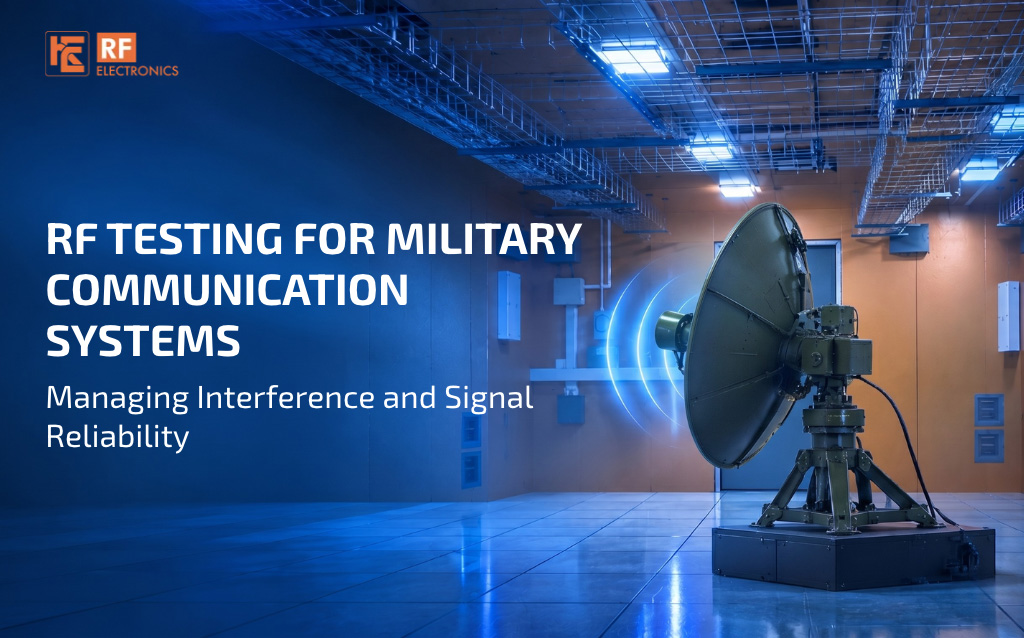
Most radios get used on ordinary days. A military radio is built for the worst one: heavy congestion, deliberate jamming, long distances, bad weather and no second chances. When a message has to get through, nobody wants to learn in the field that the radio only works well in a quiet lab.
That is the job of military communication RF testing. It proves, under controlled conditions, that equipment will do what it should when it matters, and it finds the weaknesses long before a soldier, sailor or pilot does. Here is what that testing looks at and how a good RF test setup makes the results trustworthy.
Imagine trying to test a very faint signal in a room full of Wi-Fi routers, mobile phones and other equipment. The numbers you record would drift every time something changed nearby. You could never be sure whether a result came from the radio or the room.
Controlled conditions remove that doubt. In a shielded environment, outside signals stay out and the equipment's own signals stay in, so engineers see only what they have chosen to apply. That makes defence communication testing a matter of measurement rather than guesswork, and it gives test evidence that can stand up to review.
Military radios work in crowded and contested spectrum. Friendly transmitters sit next to one another, and adversaries may try to jam the link on purpose. RF interference testing exposes the radio to known unwanted signals, such as strong nearby transmitters, adjacent-channel signals and noise, and records how it responds. Does it keep working, lose range, or drop the link altogether? Because the interferer is applied deliberately, the result is clear and repeatable.
A signal that arrives is not necessarily a signal that arrives intact. Signal integrity testing checks that the transmitted waveform is clean: correct modulation, low distortion, stable frequency and minimal unwanted emissions. A radio that sends a messy signal can interfere with its neighbours, and a receiver that handles messy signals badly can miss important data.
Sensitivity is about hearing weak signals. Receiver sensitivity testing finds the faintest signal the radio can still decode at an acceptable error rate. It is one of the most demanding measurements, because the signal level is so low that even a little stray noise can ruin the result. This is exactly where isolation pays off.
Modern military wireless communication often spans several bands, from HF through VHF and UHF to higher microwave frequencies, and many radios switch between them. Engineers check that performance holds across the entire range, including at the band edges and during switching, not only at one convenient frequency.
In defence, leakage is both a quality issue and a security one. Energy escaping from a device under test can disturb nearby equipment, reveal that testing is happening, or confuse the measurement itself. Good testing confirms that the equipment keeps its emissions where they belong.
Maybe the most important point of all: a result you cannot repeat is a result you cannot trust. Repeatability lets teams compare one design revision with the next, one production batch with another, and one lab with a second. It is also what turns test data into RF signal validation that regulators and customers can rely on.
All of the above depends on one principle: RF isolation. When the device under test is properly separated from its surroundings, every measurement gets cleaner. Weak-signal tests become meaningful, interferers can be added in precise amounts, and results stop wandering with the neighbourhood.
Isolation also protects the people and equipment around the test. Transmissions stay contained, which matters when you are working with powerful transmitters or sensitive technology.
Not every test needs a room-sized chamber. For component-level work, such as an individual radio module, an amplifier, a filter, a receiver board or an electronic assembly, an RF Shield Box for defence use is often the most practical choice. The device sits inside a sealed enclosure, connected to instruments through filtered interfaces so that signals cannot sneak in or out along the cables.
A well-built test setup typically brings together:
Because military programmes differ so much, flexibility matters. RF Electronics offers shield boxes, RF chambers and shielded rooms, with custom sizes, filtered interfaces and absorbers, so engineers can match the infrastructure to the equipment rather than the other way round. You can explore more on our defence industry page.
Military radios earn trust one test at a time. Interference, signal integrity, sensitivity, band performance, leakage and repeatability all need to be proven, and they can only be proven properly in a controlled environment. Get the isolation right, and the results mean something.
If you are developing or validating military communication equipment, talk to the RF Electronics engineers about the right shield box and test infrastructure for your programme, and see how we support defence applications.
Q1. What is military communication RF testing?
It is the process of validating military radios and wireless equipment under controlled conditions, checking things like interference handling, signal quality, receiver sensitivity and performance across frequency bands.
Q2. Why is RF isolation so important in defence communication testing?
It keeps outside signals from affecting the measurement and stops the equipment's own signals from escaping. That gives cleaner, more accurate and more repeatable results.
Q3. What is receiver sensitivity testing?
It measures the weakest signal a receiver can still decode correctly. Because the signals are so faint, even small amounts of stray noise can distort the result, which is why shielded testing is so useful.
Q4. When should I use an RF shield box instead of a larger chamber?
Shield boxes suit component-level and module-level testing, such as radio modules, amplifiers and receiver boards. Larger chambers or shielded rooms are better for complete systems and antenna work.
Q5. Can shielded enclosures be customised for military programmes?
Yes. Size, filtered interfaces and absorbers can all be specified to suit the equipment being tested and the requirements of the programme.
Next Blog
RF Testing for Drones Evaluating Remote Control, Telemetry and Wireless Connectivity
Learn More

 Free Consultation


