
Ask any drone pilot about their worst flight and the story often ends the same way: the video feed froze, the controls lagged for a second, and the aircraft went into failsafe. Nothing was wrong with the motors or the battery. The radio link simply wasn't as dependable as everyone assumed.
That is why drone RF testing matters. A drone is a flying radio platform, and everything it does, from following a command to streaming video, depends on wireless links working in messy real-world conditions. Here is what those links need to prove before the aircraft leaves the ground, and how a controlled RF environment makes the testing repeatable.
Today's UAVs rarely rely on a single radio. A typical aircraft might carry a remote-control receiver, a telemetry modem, a video transmitter, a GNSS receiver, and sometimes Wi-Fi, Bluetooth or a cellular modem as well. Together these make up the UAV communication systems that keep the pilot and the aircraft talking.
Each link has a different job and a different tolerance for failure:
Testing has to cover all of them, individually and together.
Drone remote control testing is about one question: when the pilot moves a stick, does the aircraft respond promptly and reliably? Engineers look at receiver sensitivity, range, latency, and how the link behaves as the signal gets weaker. The most important check is what happens at the edge: does the drone degrade gracefully, trigger its failsafe at the right moment, and recover cleanly when the link returns?
Command-and-control (C2) reliability is the heart of this. A link that works at one metre on the bench but fails at the first sign of noise is not a reliable link. Testing should include hopping behaviour, packet loss under stress, and reconnection time.
Telemetry is easy to overlook because it is quiet and constant, but pilots and ground software depend on it for every decision. Drone telemetry testing checks that data arrives complete and in the right order, that update rates hold up as range increases, and that the modem keeps working while other radios on the aircraft are active.
A dropped telemetry packet might only cause a flicker on a screen. A pattern of drops, though, can point to a deeper problem such as poor antenna placement or noise coupling from the drone's own electronics.
Drone antennas have a tough life. They are small, mounted close to carbon fibre, batteries and motors, and they spend the flight at constantly changing angles to the pilot. An antenna that looks perfect in a datasheet can behave very differently once it is installed in the airframe.
Good testing measures how the antenna and radio perform together, in the installed configuration, and at different orientations. Rotating the device under test while measuring is a simple way to find weak spots in the pattern before a pilot finds them in the sky.
Drones crowd many radios into very little space, and they often fly in places full of other transmitters. Drone signal interference can come from outside, such as Wi-Fi networks, other drones and industrial equipment, and from inside, such as motor controllers, power electronics and the aircraft's own transmitters.
Wireless coexistence testing asks whether the links still work when everything is switched on at once. A video transmitter running at full power right next to a GNSS receiver is a classic example. If the GNSS signal is desensitised, position accuracy suffers, and so can the safety of the flight. Coexistence problems are much cheaper to find in the lab than in the field.
Testing on an open bench has a built-in problem: you never know what else is in the air. A neighbour's router, a passing phone or another engineer's test can change your results from one hour to the next, which makes it hard to know whether a design change actually helped.
RF isolation testing solves this by separating the device from the outside world. Outside signals stay out, and the device's own transmissions stay in. That makes wireless connectivity testing more trustworthy, because the only signals present are the ones you intend. Run the same test tomorrow, or on another bench, and you can compare the numbers with confidence.
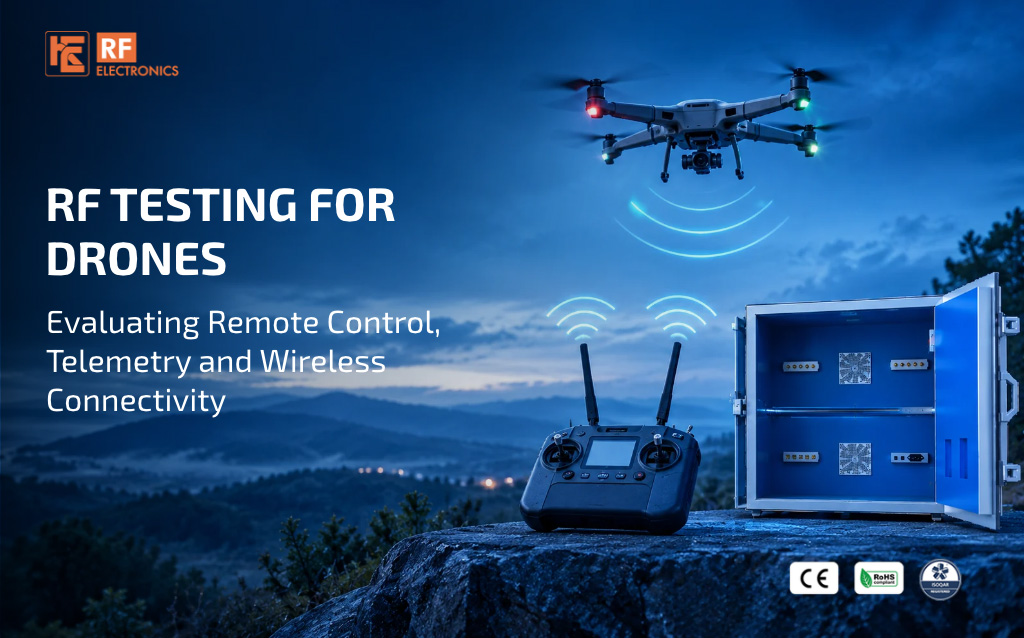
For modules and components, an RF Shield Box for drone testing is often the most practical tool. A radio module, a flight controller with its wireless link, or a complete telemetry unit goes inside the box, and the lid closes on a fully isolated space. Connections to instruments and power run through filtered interfaces, so signals cannot sneak along the cables.
That setup supports a wide range of work:
Shield boxes are small, quick to use and easy to place on a bench, which makes them a good fit for development teams and manufacturing lines alike. Larger chambers can then be used for testing complete airframes and antenna patterns. Many UAV programmes also have defence or security requirements, and you can read more about how we support them on our defence industry page.
A drone is only as dependable as its weakest wireless link. Remote control, telemetry, antennas and coexistence all need to be proven before flight, and a controlled RF environment is what makes that proof repeatable. Catch the problems on the bench, and the pilot never has to meet them in the air.
If you are building or validating UAV communication systems, speak with the RF Electronics engineers about the right shielded setup, and take a look at our defence solutions.
Q1. What is drone RF testing?
It is the process of checking that a drone's wireless links, including remote control, telemetry, video and navigation, work reliably, even in the presence of interference and other onboard radios.
Q2. Why is drone telemetry testing important?
Telemetry feeds pilots and ground software with position, battery and status data. Testing makes sure it arrives complete, on time and without interruption across the whole range.
Q3. What causes drone signal interference?
Outside sources like Wi-Fi networks and other transmitters, plus internal sources such as motors, power electronics and the drone's own radios running close together.
Q4. How does an RF shield box help with UAV RF testing?
It blocks outside signals and contains the device's own transmissions, giving clean, repeatable measurements of sensitivity, output power and link behaviour.
Q5. Can the same shield box be used for different drone modules?
Often yes. Many modules for remote control, telemetry and Wi-Fi can be tested in the same enclosure, with the right fixtures, antennas and filtered interfaces. The best setup depends on the device and frequency range.
Previous Blog
RF Testing for Military Communication Systems Managing Interference and Signal Reliability
Learn MoreNext Blog

What Causes False Failures in Wireless Device Testing
Learn More

 Free Consultation


