
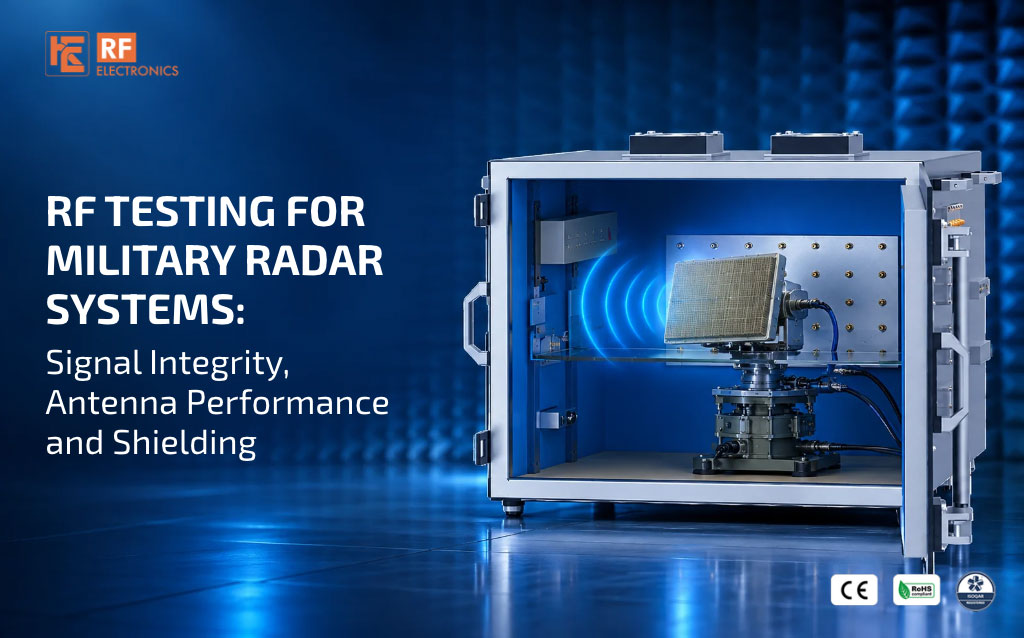
A radar has one job: tell the truth about what is out there. It sends a pulse into the sky, listens for the faint echo that comes back, and turns that echo into a decision. If the pulse is distorted, the antenna is off, or stray noise sneaks into the receiver, the picture it paints can be wrong, and in a military setting a wrong picture is expensive.
That is why Military Radar RF Testing is such a serious discipline. Before a radar ever leaves the lab, engineers need proof that every part of the chain behaves as designed. This guide walks through what gets tested, why the test environment matters so much, and how the right equipment keeps results honest.
A radar is not one device but a series of linked stages, and a weakness in any link affects the whole. Roughly speaking, it looks like this:
Good radar RF testing follows the same chain, checking each stage on its own before the whole system is put together. This stage-by-stage approach is often called radar subsystem testing, and it is the fastest way to find out where a problem lives.
RF transmit receive testing is the heart of the work. On the transmit side, engineers measure output power, frequency accuracy, pulse shape, rise and fall times, and unwanted emissions. A pulse that is too slow to rise or that rings afterwards can blur the radar's view of nearby targets.
On the receive side, the questions flip. How faint a signal can the receiver still detect? How well does it recover after a strong pulse? How much noise does it add? These are small, delicate measurements, and they are easily spoiled by anything stray in the environment.
Radar signal integrity is about whether the waveform stays clean from start to finish. Engineers look for distortion, phase noise, spurious signals and unwanted harmonics. Modern radars often use complex modulated waveforms, such as chirps, and they depend on precise phase and timing. A small error can reduce range resolution or hide a weak target beside a strong one.
This is also where radar component validation comes in. Individual parts, such as amplifiers, filters, mixers, switches and oscillators, are tested separately so that problems are found while they are still cheap to fix.
The antenna is where the radar meets the outside world. Antenna performance testing covers gain, beam shape, sidelobe levels, polarisation and pointing accuracy. Sidelobes matter in particular, because energy leaking in the wrong direction can make a radar more vulnerable to interference and less accurate.
Antenna measurements need a very quiet, low-reflection space. Any echo from a wall or a bench adds to the measurement and quietly changes the answer. This is why dedicated chambers are so valuable.
Radars live in crowded surroundings. Other radars, communication links and electronic systems all compete for spectrum, and a radar's own transmitter can swamp its receiver if the two are not kept apart. RF shielding addresses both problems: it keeps unwanted signals out of sensitive measurements, and it keeps the radar's high-power emissions from leaking where they should not.
Controlled shielding also makes testing safer and more discreet, since strong test signals stay contained rather than radiating into the surrounding area.
For component-level work, an RF Shield Box is the everyday workhorse. A receiver module, an amplifier board or a filter goes inside a sealed, isolated enclosure, and the measurement happens without outside signals getting in or test signals getting out. Filtered interfaces carry power and data through the wall without letting noise follow.
When the test involves an antenna or a larger assembly, RF Chambers for radar testing step in. Shielding keeps outside interference away, while absorbers on the walls soak up reflections, so the antenna effectively sees open space. Turntables and positioners let engineers measure patterns from every angle without disturbing the setup. Size, absorbers and turntables can all be customised to suit the equipment.
It is easy to forget the cables, but at radar frequencies they matter a great deal. High-frequency RF cables and connectors carry signals between instruments and the device under test, and a poor one can add loss, reflections or phase error that looks exactly like a fault in the radar. Quality coaxial cables, careful handling and regular inspection keep that source of error under control.
Radar development is a long series of small improvements. A new filter here, a software tweak there. To know whether each change really helped, engineers must be able to compare today's measurement with last month's. If the test room changes from day to day, that comparison is meaningless.
A controlled test environment, built from shielding, absorbers and good cables, gives you the same conditions every time. That means results can be compared across design revisions, production batches and even different labs. It also produces cleaner evidence for formal validation, where results must stand up to scrutiny.
Practical Habits for Better Radar Testing
A military radar earns confidence one measurement at a time. Transmit and receive chains, signal integrity, antenna behaviour and interference control all need proof, and that proof is only as good as the environment it came from. Start with a controlled, repeatable setup and the rest gets easier.
If you are developing or validating radar electronics, speak to the RF Electronics engineers about the shield boxes, chambers and test infrastructure that fit your programme, and see how we support defence applications.
Q1. What is military radar RF testing?
It is the process of validating a radar's RF components, transmit and receive chains, signal quality, antenna performance and interference behaviour under controlled conditions.
Q2. Why is radar subsystem testing done before full system testing?
Testing each stage separately makes it much easier to locate the source of a problem, and it is usually faster and cheaper to fix issues at component level than after integration.
Q3. How does an RF Shield Box help with radar component validation?
It isolates the component from outside signals and contains its own emissions, giving clean, repeatable measurements of things like gain, noise and output power.
Q4. When do I need an RF chamber instead of a shield box?
Chambers are better suited to antenna measurements and larger assemblies, because absorbers reduce reflections and turntables allow measurements from different angles.
Q5. Why do RF cables matter in radar testing?
At high frequencies, cable loss, reflections and phase errors can distort results. Quality high-frequency cables and connectors keep those errors small and consistent
Previous Blog
RF Testing of Wireless Medical Devices Managing Interference and Connectivity
Learn MoreNext Blog
RF Testing for Military Communication Systems Managing Interference and Signal Reliability
Learn More

 Free Consultation


